
The Quiet Power of the Handmade: Botanical Art in the Age of AI
BOTANICAL LETTERS – Issue No. 3
Written by Cleidi Hearn
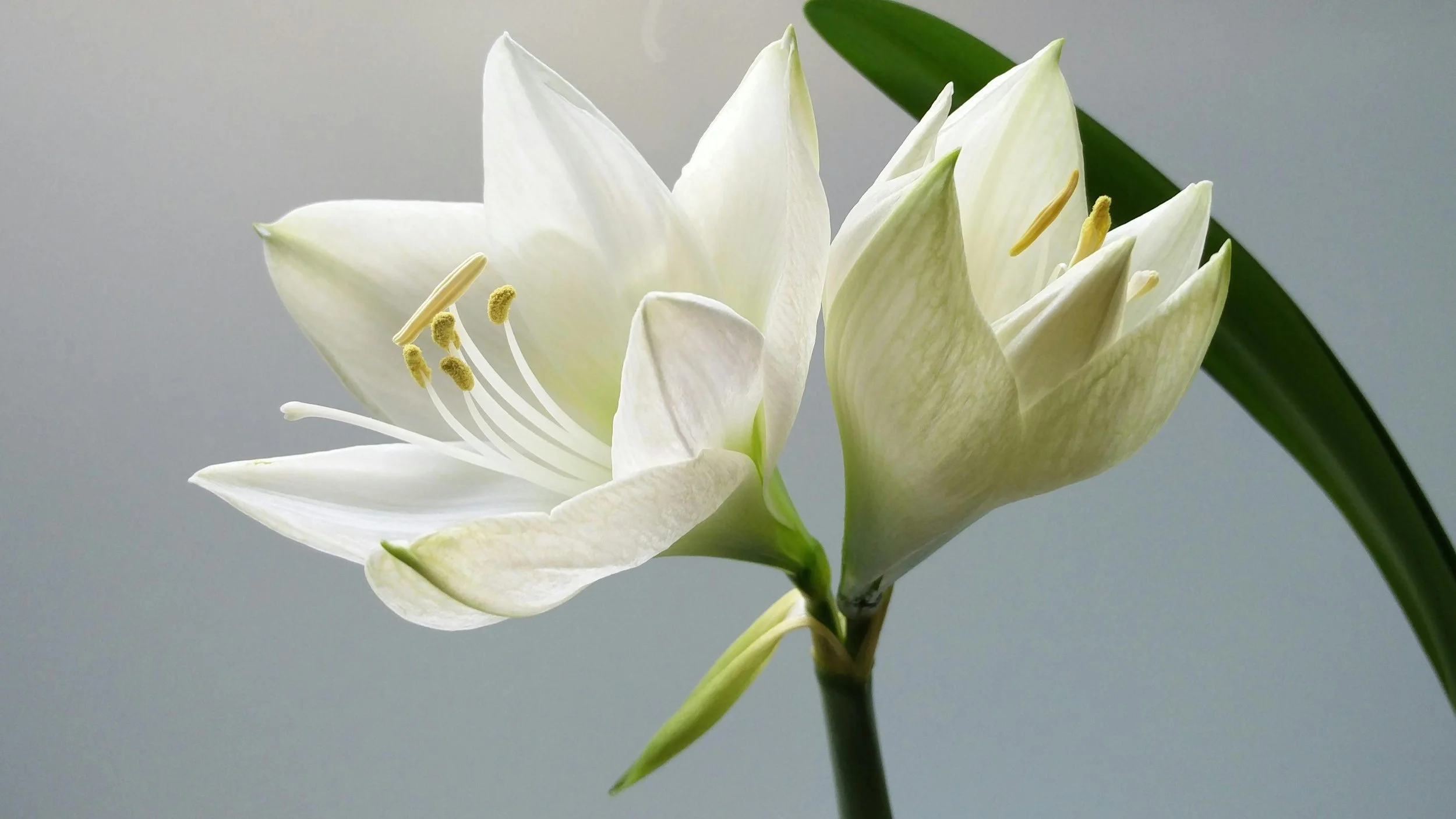
White Amaryllis is a symbol of purity, innocence and new beginnings. Photo by Tomas Williams.
Preserving Humanness in a World That Moves Too Fast
Each December, as the year exhales its final breath, life seems to shift into a softer register. The pace loosens, the light changes, and suddenly there is room again to notice the things we’ve hurried past—the textures that comfort, the stories that anchor, the objects that feel undeniably human.
It is often in this slower interval that the handmade reveals its quiet power.
In a world increasingly shaped by artificial intelligence, the handmade is no longer simply a preference. It has become a form of clarity. AI can manufacture botanical images in seconds, infinitely and impeccably. Yet what it cannot create is experience—the slow attention required to truly see a plant, the delicate hesitation before committing pigment to linen, the cultural memory that informs each gesture.
Handmade botanical art carries its own kind of intelligence: attentive, lived, embodied.
This is the foundation of Botanica Brasilis, a studio born from the meeting of two worlds—Brazil’s abundant flora and the founder’s past life working with technology. That dual awareness gives the studio a rare perspective on the moment we are living through. AI is not an adversary; it is simply not a substitute. The hand is not an anachronism; it is an anchor.
History has been here before.
When machines reshaped production in the nineteenth century, the Arts & Crafts movement emerged not just as resistance but as reminder: that beauty shaped by touch holds a different kind of value. Art Nouveau followed, bringing botanical fluidity into modern design and proving that human interpretation—not mechanical imitation—is what gives natural forms their expressive power.
Botanica Brasilis stands in quiet continuity with this lineage. Every piece is hand-painted on natural European linen, chosen for its longevity, breathability, and honest texture. The plant’s Latin name appears on the front; the studio’s signature rests discreetly on the back. The message is simple: the plant, not the artist, is the protagonist.
A Color for This Moment: Cloud Dancer
Pantone’s 2026 Color of the Year, Cloud Dancer, enters the cultural palette at an unusually fitting time. A luminous off-white with a softness that feels almost atmospheric, it embodies the very things many of us crave as the year closes: simplicity, quiet, and a sense of spaciousness.
Cloud Dancer is not blank; it is open.
Not loud; but full of light.
It mirrors the ethos of Botanica Brasilis with uncanny precision.
The studio’s work has always embraced intentional space—uncluttered compositions, gentle negative areas, a palette that lets each botanical subject breathe. Linen, with its subtle irregularities, harmonizes naturally with the clean calm of Cloud Dancer. The colour evokes the same qualities that guide the studio’s practice: clarity, restraint, and a kind of grounded luminosity.
Cloud Dancer also speaks to a broader cultural shift toward honesty in materials. In a landscape dominated by digital abundance, people are turning toward objects that feel anchored—textiles with weight, colours with quiet depth, pieces shaped through time rather than speed.
Cloud Dancer does not simply suit this philosophy; it articulates it.
The Endurance Of The Handmade
As AI makes botanical images more accessible than ever, the handmade becomes something deeper than aesthetic preference. It becomes a reminder that:
Presence still matters.
Heritage still matters.
The relationship between human attention and the natural world still matters.
A hand-painted botanical artwork does not exist to compete with digital efficiency. It exists to slow a room, to hold a story, to offer the tactile assurance that someone stood before a living plant—studied it, honoured it, translated it through gesture and pigment and linen.
A Quiet Closing for the Year
As the year folds into its final days, Cloud Dancer offers a symbolic clarity—an invitation to breathe, to edit, to return to what feels essential. And perhaps that is why the handmade feels so compelling right now: it represents the kind of knowing that cannot be automated, hurried, or reproduced.
Botanica Brasilis continues to honour that knowledge through each original work: slow, attentive, shaped by hand, rooted in nature.
And in a world increasingly defined by AI-generated images, that quiet power endures.
