
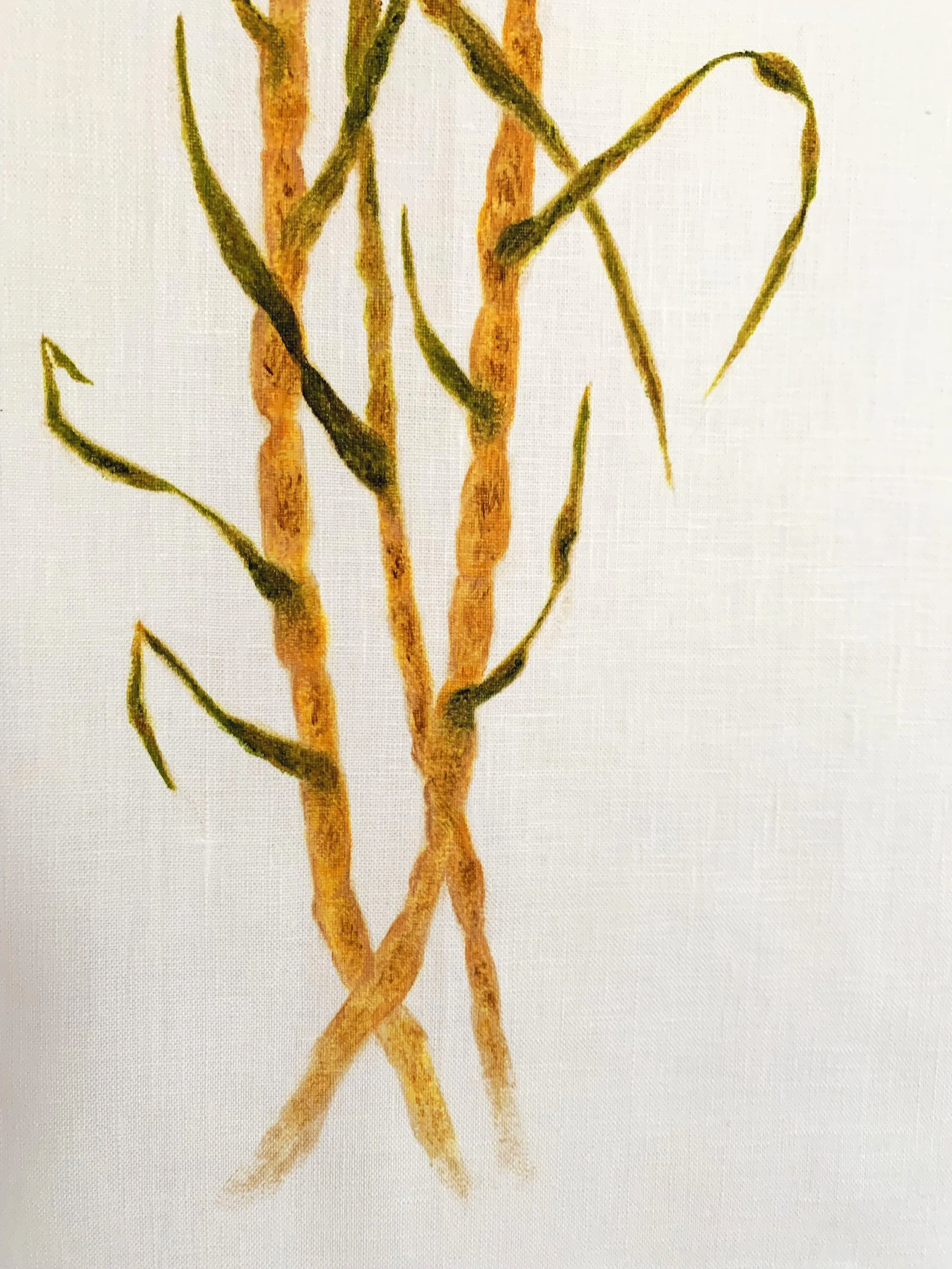
Botanica Brasilis is a contemporary textile painting practice exploring cultivated plants as carriers of ecological and cultural memory.
Founded by Brazilian-born artist Cleidi Hearn and based in Ireland, the practice centres on agricultural plants shaped through generations of human cultivation. Sugarcane, cassava, and other cultivated plants appear throughout the work not as botanical subjects, but as living traces of labour, migration, culture, time, and environmental transformation.
The paintings emerge from memory and geographic distance.
Living in Europe while working from remembered agricultural plants in Brazil, Hearn reconstructs vegetal forms through recollection rather than direct observation. Layered pigment and repeated brushwork allow the plants to surface slowly through the linen, carrying the instability of memory itself: fragmented, shifting, and partially preserved across time.
At the centre of the practice is the proposition that cultivated plants hold memory.
Not memory as nostalgia, but as accumulation. Repeatedly planted, harvested, transported, traded, and lived through, agricultural species absorb the histories surrounding them. They carry embedded knowledge of climate, seasonal rhythms, manual labour, displacement, adaptation, and inherited relationships between land and survival.
Cultivated species recur throughout the practice as part of an expanding visual archive. Sugarcane forms the starting point of this investigation, appearing in the first series as a plant deeply connected to histories of colonial trade, forced movement, extraction, and land transformation across the Atlantic world. Future works continue this inquiry through other cultivated plants, each approached as a material witness to intertwined human and ecological histories.
The works do not attempt to illustrate these histories directly. Instead, such histories remain suspended within the visual language of the paintings themselves: repetition, erosion, fragility, absence, and slow accumulation. Plants reappear across diptychs, triptychs, and serial groupings that echo the cyclical rhythms of cultivation, harvest, and replanting while allowing each species to unfold gradually across multiple surfaces rather than as isolated images.
Each scroll is hand-stitched and painted entirely by hand, allowing the pigment to settle gradually into the linen surface through layered translucent applications. The slow accumulation of brushwork mirrors the repetitive temporal rhythms of agricultural labour itself. The linen remains visible throughout, allowing image and material to exist together without separation. Rather than functioning as a neutral support, linen carries its own agricultural and tactile history — cultivated, woven, handled, and marked through time.
Presented as suspended scrolls, the works exist between painting, textile, and archive. Their vertical format isolates each plant within an open field of linen, creating a quiet spatial presence that recalls both devotional objects and archival fragments. The restrained palette of earth pigments, oxidised yellows, softened greens, and weathered vegetal tones reinforces the sense of material memory embedded within the work.
Through this ongoing archive of cultivated plants, Botanica Brasilis explores how agriculture shapes not only landscapes and economies, but also cultural consciousness, inherited knowledge, and ways of remembering across generations.